The Modern Warehouse: A Field Guide to Industrial Robotics
This guide covers the major robotic platforms now running at scale, who is deploying them, and what actually drives the decision to choose one over another.

Spend enough time on a warehouse floor and you stop noticing the robots. That is partly a function of familiarity, but it is mostly a function of how well-integrated these systems have become. The fork lifts are still there, the people are still there, but threaded between them is an entirely new category of machinery that has quietly absorbed the most repetitive, physically demanding, and error-prone parts of the operation. This guide covers the major robotic platforms now running at scale, who is deploying them, and what actually drives the decision to choose one over another.
Navigation and Mobility
AGVs vs. AMRs
The clearest way to understand the difference between Automated Guided Vehicles and Autonomous Mobile Robots is to think about the relationship between a vehicle and its environment. An AGV is built around a fixed route. Magnetic tape, embedded wires, laser reflectors, or vision markers define a path through the facility, and the robot follows it with high precision day after day. An AMR, by contrast, builds its own map using a technique called SLAM, updates it in real time, and decides moment-to-moment how to get from point A to point B. One system is designed around the assumption that the environment stays the same. The other is designed around the assumption that it will not.
That distinction drives almost every downstream decision in a warehouse robotics deployment, from infrastructure investment to maintenance contracts to the amount of change management required when the operation evolves.
Automated Guided Vehicles (AGVs)
Daifuku, JBT Corporation, Dematic (part of KION Group), Kuka, and Toyota Industries lead the AGV market, with customer bases concentrated in automotive manufacturing. Ford, Toyota, General Motors, Mercedes-Benz, BMW, and Volkswagen have all built AGVs into their assembly lines for component delivery, and for good reason: in a facility where the layout is essentially fixed and the workflow repeats thousands of times a day, a predetermined path is not a constraint, it is a competitive advantage. There is no on-the-fly decision making to go wrong, no sensor misread that causes an unexpected reroute. The robot goes where it is supposed to go, carries what it is supposed to carry, and arrives when it is supposed to arrive.
The downside shows up the moment the operation needs to change. Rerouting an AGV system is not a software update. It typically requires physical infrastructure changes, downtime, and in some cases a significant capital outlay. Facilities that run the same process for years get tremendous value from AGVs; facilities that need to reorganize their floor space frequently find that the rigidity they bought for reliability becomes a liability.
Autonomous Mobile Robots (AMRs)
Geek+, Locus Robotics, MiR (part of Teradyne), Amazon Robotics, Zebra Technologies (Fetch), OTTO Motors, and Seegrid lead a segment that has grown in near-perfect lockstep with the rise of e-commerce fulfillment. DHL, FedEx, Walmart, Nike, GEODIS, and Radial run AMR fleets at meaningful scale, and the operational logic is consistent across all of them: in an environment where order profiles change weekly and storage layouts get reorganized to match seasonal demand, the ability to deploy new robots without touching the physical infrastructure is worth a great deal.
Pick times in AMR-assisted operations typically fall by around 50% relative to manual workflows, and the swarm coordination software that manages large fleets has matured considerably. Modern systems can route hundreds of robots simultaneously, identify congestion before it develops, and rebalance workloads across the fleet dynamically. For third-party logistics providers running operations for multiple clients under one roof, that reconfigurability often means a single robot fleet can serve entirely different workflows without requiring separate hardware for each client.
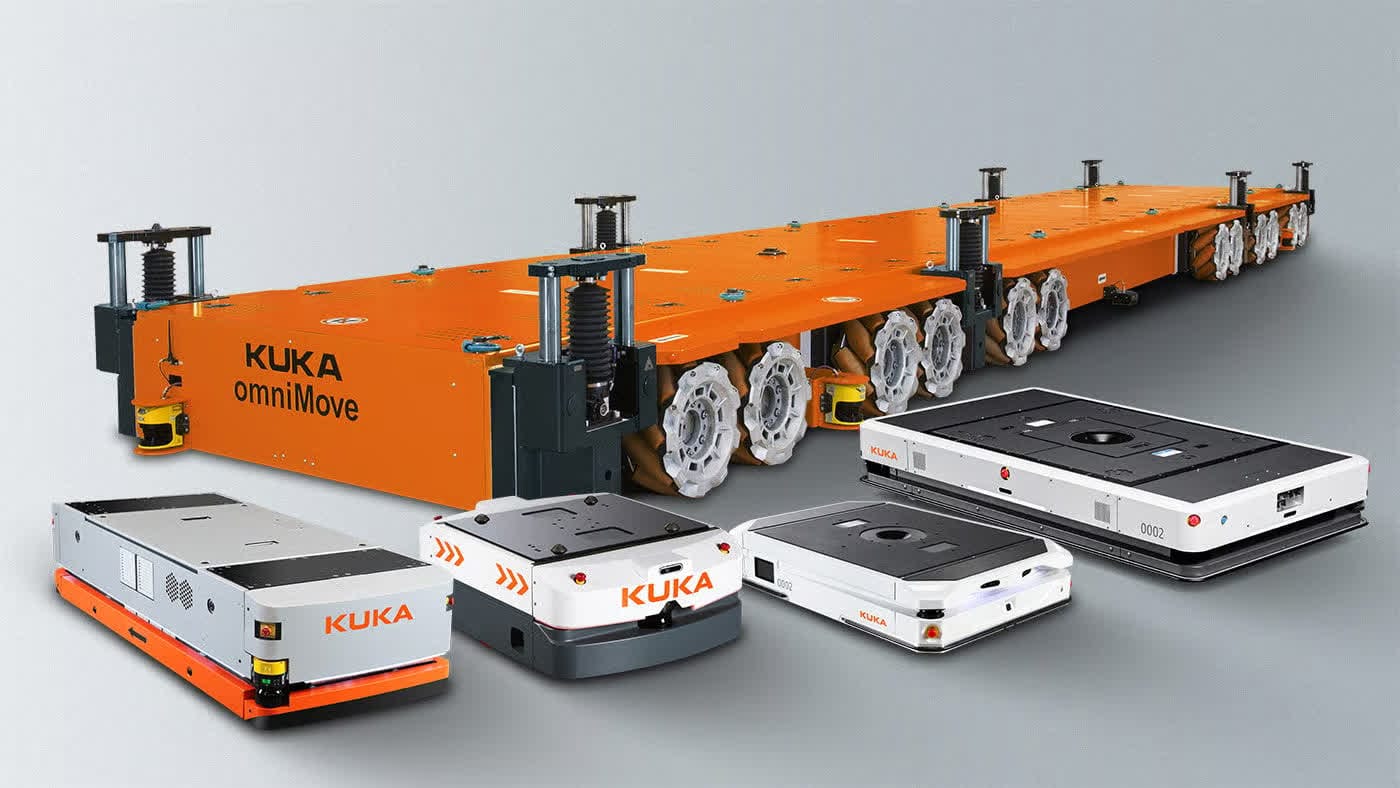
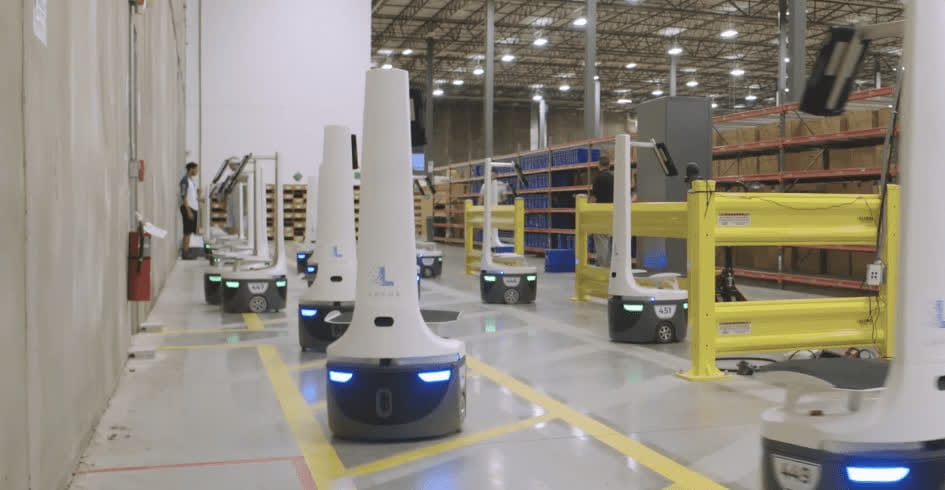
KUKA AGVs (left) & Locus AMRs (right)
Picking and Fulfillment
Goods-to-Person Systems and Cobots
Traditional warehouse picking is exhausting in a very specific way. Workers do not spend most of their time actually picking items; they spend it walking to where the items are. Industry benchmarks consistently put travel time at 50 to 60 percent of a picker's shift, which means that before any discussion of speed or accuracy, a significant portion of human labor in a conventional warehouse is being consumed by locomotion. Goods-to-Person systems address this by inverting the model entirely, while collaborative robots address it by making the walking that remains more efficient and less physically demanding.
Goods-to-Person (GTP) Systems
Amazon Robotics is the dominant force in this space, with over a million robots deployed globally across its own fulfillment network. Geek+, GreyOrange, Exotec, and AutoStore offer modular alternatives that serve the broader market. Walmart has deployed Symbotic's GTP platform across its distribution centers, while Kroger's partnership with Ocado represents one of the most ambitious grocery fulfillment buildouts in North American retail history. Decathlon has similarly invested heavily in GTP for its high-SKU sporting goods distribution.
The productivity gains are well-documented and consistent: GTP multiplies pick rates by three to four times compared to conventional walking-based operations. Storage density in a GTP-configured facility also improves substantially because inventory can be organized for retrieval efficiency rather than human navigation, which allows the same building footprint to hold significantly more product. In perishable categories, the speed improvement has quality implications beyond just throughput, since faster cycle times translate directly into fresher product reaching the end customer.
Collaborative Robots (Cobots)
Universal Robots, Locus Robotics, Teradyne, and ABB Robotics are the leading cobot vendors, and their customers tend to be operations where full automation is not practical but human-only workflows are leaving measurable productivity and safety performance on the table. GEODIS, Radial, DHL, and UPS all run hybrid picking operations where cobots handle the physical burden and route guidance while humans manage judgment-intensive exceptions.
Productivity gains of two to three times over unassisted picking are typical, but the more significant long-term impact in many operations has been on workforce retention. Warehouse injury rates, particularly repetitive strain injuries from walking with heavy loads over long shifts, drop considerably when cobots absorb that physical burden. Workers who are less exhausted and less injured stay longer, which matters a great deal in an industry that has historically struggled with turnover. The cobot also scales in a way that hiring does not: adding capacity during a peak season does not require recruiting, onboarding, and training a new cohort of workers on a compressed timeline.
The Stationary Backbone
Robotic Arms, ASRS, and Sorters
Not everything in a warehouse needs to move through the facility. Some of the most consequential automation in modern distribution takes place in a fixed footprint, doing work that mobile robots cannot do and humans find either too slow, too variable, or too physically demanding to sustain at volume. Robotic arms and automated storage systems represent the two ends of this category: one handles individual items with increasing dexterity, the other reconfigures how space itself is used.
Robotic Arms and Picking Systems
FANUC, ABB Robotics, Yaskawa, RightHand Robotics, and Covariant are the key players in what the industry has started calling Physical AI, which refers to systems that learn dexterous manipulation from observed data rather than being explicitly programmed for every item type. The practical implication is significant: where a traditional industrial arm needed extensive engineering work to handle a new SKU, a modern learning-based system can generalize to unfamiliar objects with substantially less human intervention. UPS, FedEx, Nestle, and major e-commerce operators have deployed these systems for sorting, packing, and returns processing.
Returns processing is worth calling out specifically because it represents one of the harder unsolved problems in e-commerce logistics. Returned items arrive in unpredictable conditions, orientations, and states of packaging. A rigid programmed system cannot handle that variability reliably; a vision-guided learning system handles it far better, which is why returns automation has become one of the more active deployment areas for advanced robotic arms in recent years. In food manufacturing, the addition of hygiene-compliant arm designs that can be fully sanitized has opened up applications that were previously inaccessible to robotic handling.
Automated Storage and Retrieval Systems (ASRS)
AutoStore, Swisslog, Exotec, Daifuku, and Dematic are the major integrated platform providers. Kroger's Ocado-powered facilities, H&M's European distribution centers, and ASOS's fulfillment operations are among the most frequently cited deployments, but the technology has spread broadly across grocery, pharma, and general retail.
The core value proposition is vertical space utilization. A conventional warehouse typically uses its upper cubic footage for nothing useful; an ASRS reconfigures that space into active inventory, with well-documented examples of facilities achieving storage capacity increases of 400% within an existing building envelope. That figure matters because building new distribution space, particularly near population centers where land is expensive and zoning is complex, has become extraordinarily costly. Urban micro-fulfillment facilities running on ASRS can now compete on delivery speed with much larger conventional warehouses located further from the customer, because the proximity advantage offsets the smaller footprint.
The New Frontier
Humanoid Robots and Autonomous Forklifts
The most interesting question in warehouse robotics at the moment is not about any specific robot type. It is about the relationship between facility design and robot capability. Every system discussed so far was deployed into a facility that was, to varying degrees, modified to accommodate it. AGVs required path infrastructure. GTP systems required storage grid installations. ASRS required the facility to be built or retrofitted around a specific vertical storage architecture. Humanoid robots represent a different bet: that the hardware can eventually be capable enough to work in facilities designed entirely for humans, with no modifications required.
Humanoid Robots
Agility Robotics (Digit), Figure AI, Apptronik, Boston Dynamics (Atlas), and Tesla (Optimus) are the most visible companies in a segment that has attracted substantial investment and considerable skepticism in roughly equal measure. Amazon is piloting Digit for tote handling, BMW is working with Figure AI on assembly assistance, and GXO Logistics is exploring inspection applications. The use cases are real, but the operational constraints are also real: most current humanoid platforms offer two to four hours of runtime between charges, which compares unfavorably to the ten to twenty hours of continuous operation expected from an AMR in a production environment.
The longer-term workforce question is worth taking seriously. As humanoids take on physical tasks currently performed by human workers, the role of the logistics workforce will shift toward oversight, quality control, and system management. That transition requires reskilling investment, and the timeline for when humanoids become economically viable at scale in logistics is genuinely uncertain. The technology is advancing faster than most people expected five years ago, but the gap between an impressive demonstration and a reliable production deployment has historically been wider in robotics than in almost any other technology category.
Autonomous Forklifts
VisionNav, Third Wave Automation, Cyngn, Balyo, and Yale are the main vendors developing AI-driven autonomous forklifts, and the customer base skews toward high-volume distribution operations where heavy material handling runs continuously. PepsiCo, Tyson Foods, and Coca-Cola have deployed autonomous forklifts in distribution centers where the combination of load weights, operating hours, and shift scheduling makes human-operated equipment an ongoing safety and productivity challenge.
Forklift-related accidents are among the most serious injuries in warehouse and distribution environments, and autonomous operation reduces incident rates substantially because the robot does not get fatigued, distracted, or rushed. Fleet management software optimizes routing across the entire facility rather than relying on individual operators to make navigation decisions in real time, which produces more consistent throughput across a shift. Cold storage environments present a particular case for automation: human shift lengths in sub-zero conditions are tightly regulated for health and safety reasons, which creates operational gaps that autonomous vehicles fill without restriction.
Summary
None of the systems in this guide operates in isolation, and the best-performing facilities are not the ones that found the single right robot. They are the ones that figured out how to layer these technologies in a way that fits their actual operation. AGVs and AMRs address different problems and often coexist in the same facility. GTP and cobots solve for the same root cause through different mechanisms. ASRS and robotic arms handle different parts of the same workflow. The practical question for any operator is not which robot wins, but which combination of capabilities addresses the specific bottlenecks in their particular operation, at a cost and timeline that makes financial sense.
The hardware costs across all of these categories have been falling for years, and the software to manage complex multi-system environments has matured considerably. The barrier to entry for serious warehouse automation is lower now than it has ever been, which means more operations are reaching the point where the economics work. What that looks like five years from now is genuinely uncertain, but the direction of travel is not.
Thanks for reading - consider subscribing!
More on The Modern Warehouse & Automation
- IFR World Robotics 2025 Report – Global installation trends and market share.
- Standard Bots: Best AMR Manufacturers & Autonomous Mobile Robot Companies – Top AMR companies in 2025.
- AboutAmazon: Amazon deploys over 1 million robots – How Amazon uses over 1 million robots.
- Locus Robotics Blog: 2025 Warehouse Automation Trends – 2025 warehouse automation trends.
- Robotics & Automation News: Top 30 Warehouse Robotics Companies – Top warehouse robotics companies.
- Coherent Market Insights: Warehouse Robotics Market Size & Opportunities 2025-2032 – Market size and opportunities.
- Swisslog: AutoStore Case Studies and SynQ Software – Case studies on AutoStore integration.
- Nomagic.ai: How AI-Powered Robots are Reshaping Warehouse Efficiency in 2025 – AI-powered robots in warehouses.
- McKinsey & Co: Humanoid Robots – Crossing the Chasm to Commercial Reality – Humanoid robots commercialization.
- SiliconANGLE: Physical AI and the New Era of Smart Machines (Dec 2025) – Physical AI era.
- Newo.ai: The Rise of the Digital Workforce in 2025 – Rise of digital workforce with humanoids.