The Drone That Gets There in 15 Seconds: Inside Campus Guardian Angel's School Security System
Campus Guardian Angel deploys drones pre-positioned inside school buildings to reach an active threat in 15 seconds. Here is how the system works, who is behind it, and where it is being deployed.
The standard response time problem in an active shooter event is not really about how fast police can drive. In most cases, officers arrive within three to five minutes of a call, which by the standards of emergency response is genuinely fast. The problem is that in a school shooting, most of the casualties happen in the first two minutes, before anyone with authority to intervene has eyes on the threat. The gap between alarm and first contact is where the damage is done, and it is a gap that has not changed meaningfully in decades of updated protocols and increased school resource officer budgets.
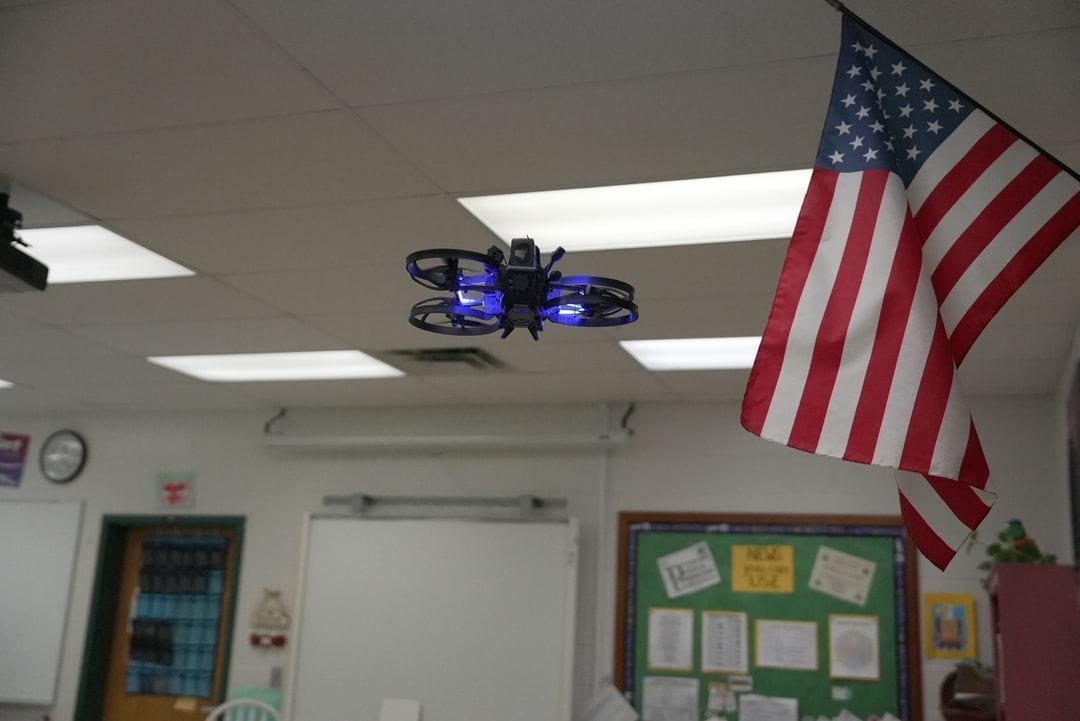
Campus Guardian Angel is an Austin-based startup founded in December 2023 that is building a system designed specifically to close that gap. The company places boxes of six pre-positioned drones inside school buildings, connects them to a digital map of the facility, and staffs a remote operations center with former military and law enforcement personnel who can have a drone on a threat within 15 seconds of an alarm. The drones carry no firearms. They carry pepper spray launchers, strobe lights, sirens, and window-breaching lances, and in a last resort, they can be flown directly into an assailant at speed. The goal is not to stop the shooter with lethal force. It is to buy the two minutes that currently belong entirely to the attacker.
The People Behind It
The company was co-founded by Justin Marston, a defense tech entrepreneur who serves as CEO, and Bill King, a retired Navy SEAL with 32 years of service who serves as Chief Tactical Officer. King planned and executed both in-person hostage rescues and remote Predator drone strikes during his career, which gives him an unusual frame of reference for the problem Campus Guardian Angel is trying to solve: the mechanics of remote-operated precision response in time-critical environments are not conceptually different from what he spent decades doing at much larger scale.
Marston has said the idea came directly from watching drone warfare in Ukraine, specifically how inexpensive small drones proved effective against armed combatants even when those combatants knew the drone was coming and were actively shooting at it. The lesson was that speed and replaceability change the tactical calculus. A drone that costs a few thousand dollars and reaches a target in 15 seconds presents a fundamentally different threat profile than a human responder who takes three minutes to arrive and cannot absorb gunfire.
How the System Works
The physical infrastructure is straightforward by design. Boxes, each containing six drones on charging pads, are distributed at multiple locations throughout a school building before the system goes live. The positioning is calculated based on the school's layout so that any room on campus is within 15 seconds of the nearest box. The drones sit dormant and secured until an alarm is triggered; the company is explicit that they are not used for surveillance during normal school hours.
Each school is mapped into a digital twin, a high-precision 3D model of the facility that integrates the building's existing sensor infrastructure, surveillance cameras, and access control systems. When an alarm activates, the operations team in Austin has immediate spatial awareness of the entire building, including the ability to cross-reference alarm triggers with camera feeds to identify where the threat is and select which drone box to activate first. Pilots navigate using the digital twin as their primary reference rather than relying solely on camera feeds, which means they can navigate hallways and corners with the full context of the building's geometry even in areas where camera coverage is limited.
What the Drone Can Do
The drones themselves are described as shoebox-sized and are capable of 30 to 50 miles per hour indoors and 100 miles per hour in open outdoor spaces. The hardware is built for maneuverability in confined spaces, not endurance, because the operational window the company is designing for is measured in seconds rather than minutes. Each unit carries a combination of payloads that can be deployed in sequence depending on how the situation develops.
The less-lethal classification is deliberate and legally meaningful. Under Texas law, Campus Guardian Angel's drones are classified as less-lethal devices, which allows them to be deployed on school grounds without the legal and political complexity of arming a drone with a firearm. Marston has noted that this classification also changes the tactical decision-making for pilots: because the drones cannot kill, pilots can act faster and with more confidence in ambiguous situations, including taking fire from the assailant, without the legal exposure that lethal force creates.
The Case Against the K9 Unit
One of the more pointed arguments Campus Guardian Angel makes is directed specifically at the police K9 unit as a model for high-risk tactical entry. K9s are the primary tool for clearing rooms, flushing barricaded suspects, and making initial contact in situations too dangerous to send a human officer first. They are effective, and they are also biological assets whose loss carries both emotional and operational cost. Handlers are trained to protect their dogs, which creates a second responder whose safety has to be managed simultaneously with the tactical situation.
A drone does not require that calculation. If a drone is destroyed during entry, it is a hardware loss, not a casualty, and the next drone in the box is already ready. Campus Guardian Angel's framing is that this replaceability is not a clinical efficiency argument but a structural one: the reason K9s go first is that they are more expendable than humans, and the reason drones should go first is that they are more expendable than K9s. The tactical logic that justified building K9 units into law enforcement applies with even more force to a remote-operated robotic platform.
Where It Is Being Deployed
Boerne ISD, a growing district about 30 miles north of San Antonio, was among the first Texas school districts to sign on for a pilot program. The district's Chief of Safety and Security, Rick Goodrich, a former DEA special agent and Air Force veteran, has said the primary value proposition is real-time situational awareness in the minutes before officers arrive, specifically the ability to tell responding officers which part of the building the threat is in before they make entry decisions that could cost them their lives.
As of late 2025, Campus Guardian Angel was running a 500-drone pilot program across dozens of public and private schools in Colorado, Florida, Texas, and Washington DC. The company has not publicly identified most participating schools for security reasons. Florida dedicated state funds to run a test program across three school districts. Demonstrations have been held in Midland, Highland Park ISD, Waco, Conway (Arkansas), Colorado, and Utah, with law enforcement feedback described consistently as positive by the company.
On the legislative front, Texas House Bill 462, co-authored by Representatives Ryan Guillen and Trey Wharton, would expand the funding available per school for safety measures and explicitly include remote human-operated devices like drones as eligible expenditures. Texas Governor Greg Abbott signed an $8.5 billion public school funding package that included $430 million specifically for school safety, creating the budget headroom for districts to act on programs like this without needing to redirect existing funds.
The pricing model Marston has described is $4 per student per month for the managed service, which includes the remote response team on standby, and $15,000 per box of six drones. For a high school of 2,000 students, that is roughly $96,000 per year in subscription costs, plus hardware. That compares to an annual cost of $60,000 or more for a single human school resource officer, before accounting for benefits, training, and the fact that one officer cannot be in two places simultaneously.
The Spring Branch ISD Connection
SB Safe Drones, the community group you may have encountered on Instagram, is a parent-led initiative in Spring Branch ISD in Houston working to raise funds to bring Campus Guardian Angel's technology to Memorial and Spring Woods high schools, two large campuses with exterior hallways and disconnected buildings that the district's own police chief identified as particularly difficult to cover with a single officer.
The district supports the effort but has stated clearly that no district funds are currently available to sustain a drone program after any pilot, making private fundraising the path forward for those specific campuses.
What This Means
The logic here is sound, and it mirrors the pattern we see across industrial automation: the jobs that benefit most from robotic intervention are the ones that are too dangerous, too fast, or too consequential for a human to handle alone. Campus Guardian Angel is applying that logic to a domain where the stakes are as high as they get. The use case is perfect for security application; the two minutes between alarm and first human contact is where the damage happens, and that a pre-positioned robotic platform can own that window, is genuinely novel framing for a problem that has resisted every other proposed solution for decades.
Thanks for reading, read more emerging tech news here!
Read More
Texas Startup Proposes New Defense Against School Shooters: Drones - Government Technology
Campus Guardian Angel official website
Can drones fill the safety gap and protect Texas schools? - KBTX
Drone SROs? Texas startup demonstrates high-tech school solution - WFAA